What Are 2'-Fluoro Phosphoramidites?
2'-Fluoro phosphoramidites are chemically modified nucleotide monomers in which the 2'-hydroxyl group of the ribose sugar is replaced by a fluorine atom. They are incorporated into synthetic RNA or antisense oligonucleotides via standard solid-phase phosphoramidite chemistry. Fluorine (F), the most electronegative element, imparts unique stereoelectronic effects that fundamentally alter the sugar's conformational preference. Specifically, the 2'-F substitution dramatically increases binding affinity to complementary RNA targets while substantially enhancing resistance to nuclease degradation – a key chemical transformation that turns labile RNA transcripts into stable drug-like molecules.
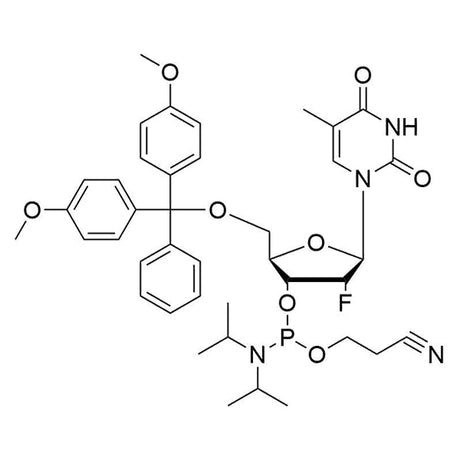
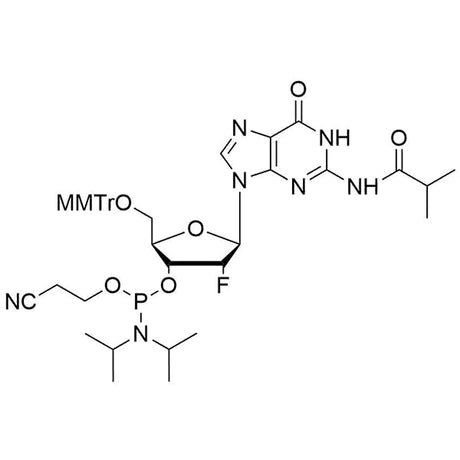
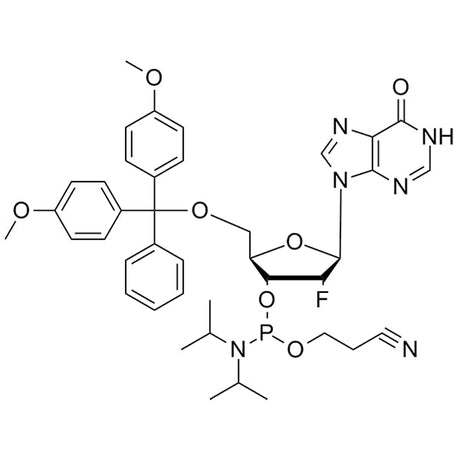
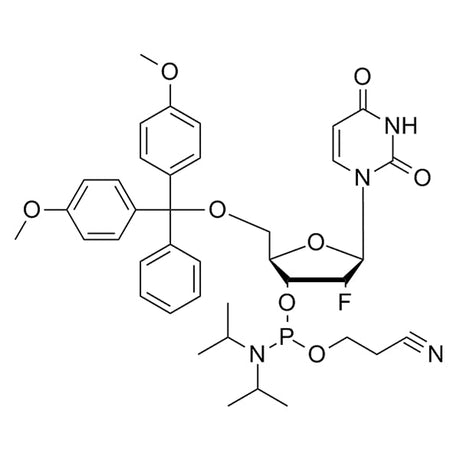
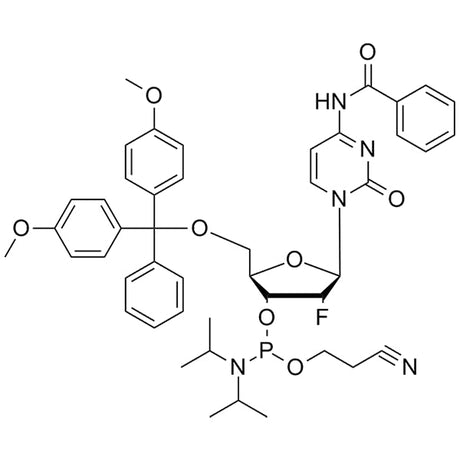
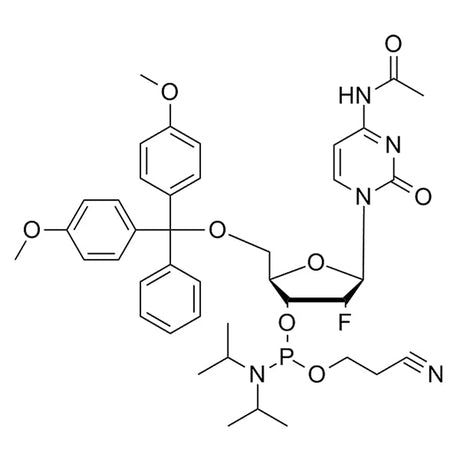
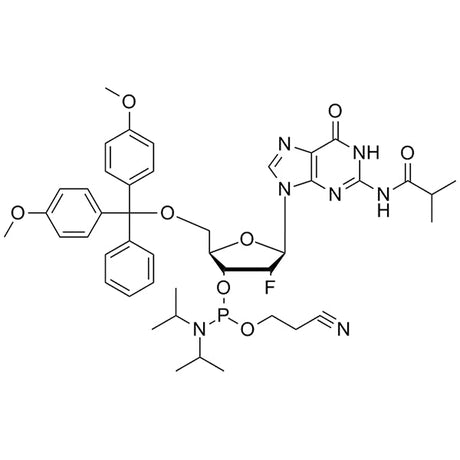
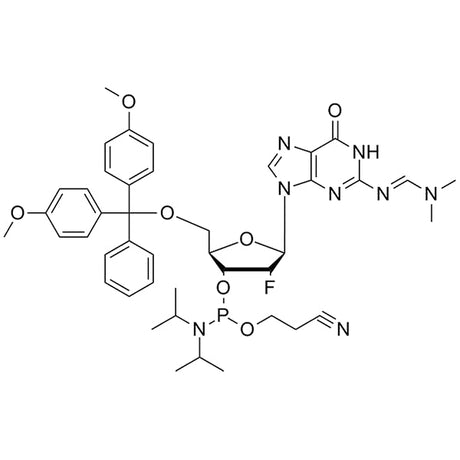
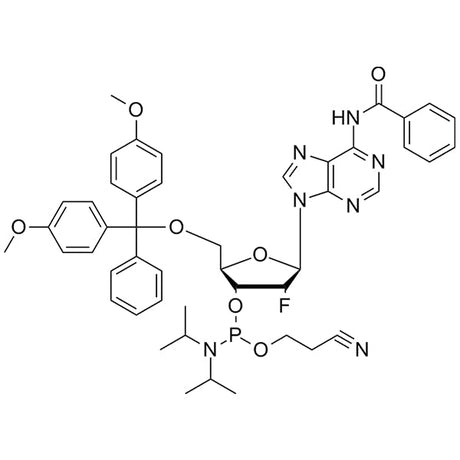
A standard 2'-Fluoro phosphoramidite monomer comprises the following structural features:
Sugar Backbone – 2'-deoxy-2'-fluororibose, where the natural 2'-OH of RNA is replaced by fluorine, providing nuclease stability while maintaining an A-form helix preference.
Nucleobase & Protecting Groups:
The base can be U, T (DNA form), A, G, C, or other base analogues.
Exocyclic amines on the base are acyl-protected, with common combinations including benzoyl (Bz) for A, isobutyryl (iBu) or dmf (fast-deprotecting) for G, and acetyl (Ac) for C to ensure compatibility with standard synthesis conditions.
Modified base versions such as 5-methyl-dC, inosine and pseudouridine are also available for specialized applications.
5'-O-DMT and 3'-CE Phosphoramidite Groups – The 5'-DMT reversibly blocks the 5'-hydroxyl, ensuring that only one monomer is added per coupling cycle. The 3'-cyanoethyl (CE) phosphoramidite group, upon activation (e.g., by tetrazole), couples to the free 5'-OH of the growing chain, and the resulting phosphite triester is oxidized to a stable phosphate diester with iodine/water.
Structure–Activity Relationship of 2'-Fluoro Modification – The fluorine atom rigidifies the ribose ring into a C3'-endo (A-form) conformation, significantly enhancing thermal stability (Tm increases of approximately 1–2℃per modification) while maintaining Watson–Crick base-pairing fidelity. This combination confers excellent nuclease resistance together with high target binding affinity, without compromising hybridization specificity.
Hongene's Core Advantages for 2'-Fluoro Phosphoramidites
Therapeutic Oligonucleotides (siRNA, ASO, Aptamers)
2'-Fluoro modification is one of the most broadly adopted second-generation sugar modifications in nucleic acid drug development. In siRNA, 2'-F modifications significantly enhance duplex thermal stability, serum stability, and gene silencing potency, while lacking immunostimulatory effects in vivo – properties that have been exploited in multiple approved siRNA drugs, including inclisiran, lumasiran and vutrisiran. In antisense oligonucleotides (ASOs), 2'-F can be used in gapmer or mixmer architectures to promote high-affinity target RNA binding and nuclease resistance, with demonstrated efficacy in splice-switching therapies for genetic diseases such as Duchenne muscular dystrophy (DMD). Macugen (pegaptanib), the first FDA-approved RNA aptamer drug, employs 2'-F on its pyrimidine residues for the treatment of age-related macular degeneration (AMD).
Ultra-High Purity & Rigorous Quality Control
All products are QC-tested by HPLC/UPLC with ≥98.0% purity as the standard, and each monomer is accompanied by a full Certificate of Analysis (CoA) covering HPLC purity, moisture content, mass spectrometry, and impurity profiles. An in-house impurity reference library enables precise tracking of degradation and process-related impurities.
GMP Compliance & Industry-Leading Large-Scale Manufacturing Capacity
Hongene operates world-leading manufacturing capacity for nucleic acid raw materials: 58 tons/year of phosphoramidites and 54,000 liters/year of NTPs, with an approximately 301,000 sq. ft. (~28,000 m²) GMP-compliant production facility. In addition, 48 flexible production lines enable seamless scale-up of API production from gram to ton scale, meeting NMPA, FDA and EMA standards. The company has been audited by multiple global pharmaceutical companies and, as one of the world's largest suppliers of mRNA vaccine raw materials during the COVID-19 pandemic, has fully validated its reliable large-scale delivery capability.
Continuous Innovation & Diversified Service Capabilities
With nearly 30 years of deep expertise at the interface of nucleic acid chemistry and biology, Hongene has developed proprietary core technologies such as its chemoenzymatic ligation platform and, through licensing agreements with leading institutions including UMass, obtained access to exNA™ and other novel backbone modification technologies – continuously expanding the modification toolbox for 2'-Fluoro and related monomers. The company offers one-stop procurement and custom synthesis services ranging from standard monomers to functionalized labeling monomers (fluorescent dyes, quenchers, biotin, GalNAc, etc.), and leverages its chemoenzymatic ligation platform to achieve higher purity and synthetic efficiency for complex oligonucleotides such as siRNA and sgRNA.
2'-Fluoro modification is one of the most broadly adopted second-generation sugar modifications in nucleic acid drug development. In siRNA, 2'-F modifications significantly enhance duplex thermal stability, serum stability, and gene silencing potency, while lacking immunostimulatory effects in vivo – properties that have been exploited in multiple approved siRNA drugs, including inclisiran, lumasiran and vutrisiran. In antisense oligonucleotides (ASOs), 2'-F can be used in gapmer or mixmer architectures to promote high-affinity target RNA binding and nuclease resistance, with demonstrated efficacy in splice-switching therapies for genetic diseases such as Duchenne muscular dystrophy (DMD). Macugen (pegaptanib), the first FDA-approved RNA aptamer drug, employs 2'-F on its pyrimidine residues for the treatment of age-related macular degeneration (AMD).
Diagnostic Probes & Detection Tools
Leveraging the high affinity and nuclease resistance of 2'-F modifications, highly sensitive and robust probes can be constructed for qPCR, FISH, Northern blot, and microarray analyses. Fluorescently labeled and quencher-labeled 2'-F probes (e.g., TaqMan probes and molecular beacons) are particularly well-suited for detecting low-abundance targets in complex biological samples.
RNA Aptamers & Functional RNA Research
2'-F modification is one of the most frequently employed chemistries in RNA aptamer development. 2'-F-modified aptamers exhibit extended serum half-lives and higher binding affinity to protein targets, making them useful for protein recognition, biosensor development, cancer biomarker detection, and targeted drug delivery systems.
Epitranscriptomics & Fundamental RNA Biology
Using 2'-F-modified monomers (including rare-base 2'-F versions such as pseudouridine (Ψ) and 5-methyl-dC), conformationally stabilized RNA analogues can be synthesized to mimic specific RNA structural and functional states, aiding studies of RNA folding, riboswitches, mRNA stability, and translational regulation.
Synthetic Biology & Drug Discovery
2'-F-modified oligonucleotides can serve as building blocks for ribozymes, CRISPR gRNAs, and mRNA IVT templates, providing chemically stabilized raw materials for genetic circuit design, gene-editing tool screening, and high-throughput drug discovery.
Structural Biology & Biophysical Studies
The conformational rigidity conferred by the 2'-F modification helps stabilize specific RNA duplex or complex conformations, making it suitable for X-ray crystallography, NMR, and related biophysical methods to study RNA–protein and RNA–small-molecule interactions.