2'-O-MOE Phosphoramidites
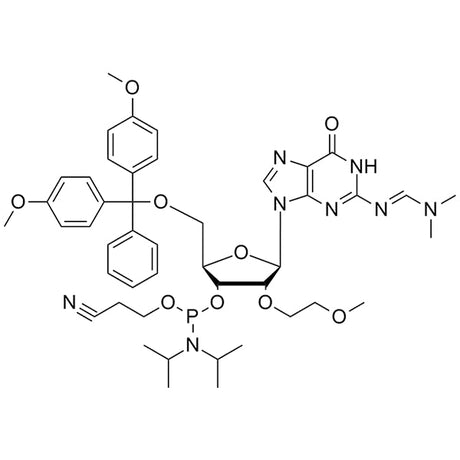
(17)General structure of 2'-O-MOE Phosphoramidites
What Are 2'-O-MOE Phosphoramidites?
2'-O-Methoxyethyl (2'-O-MOE or 2'-MOE) phosphoramidites are nucleotide monomers in which the 2'-hydroxyl of the ribose sugar is replaced by a methoxyethyl (—O—CH₂—CH₂—O—CH₃) side chain via an ether linkage. They represent the most emblematic sugar modification of second-generation antisense oligonucleotide (ASO) technology. Replacing the natural 2'-OH of RNA with this hydrophilic methoxyethyl group, the MOE modification simultaneously imparts three core properties to oligonucleotides—exceptional nuclease resistance, high target binding affinity, and low cytotoxicity—while preserving Watson–Crick base-pairing fidelity, making it the most widely used chemical modification among approved ASO drugs to date.
The structure–activity basis of MOE modification lies in its unique stereoelectronic configuration: the methoxyethyl side chain stabilizes the ribose ring in the C3'-endo (A-form helix conformation), effectively pre-organizing the oligonucleotide into an A-type duplex geometry. When a 2'-MOE-modified ASO hybridizes with complementary RNA, this conformational preference significantly elevates duplex thermal stability (Tm increases of approximately 2–4 °C per modification site). Furthermore, the MOE side chain creates a “hydration shell” around the sugar ring, shielding the backbone and substantially enhancing resistance to nuclease degradation, resulting in serum half-lives far exceeding those of natural RNA. Importantly, MOE modification has been shown to significantly reduce non-specific protein binding and immunostimulatory potential, demonstrating good in vivo safety profiles[1-5].
A standard 2'-O-MOE phosphoramidite monomer comprises the following structural features:
- Sugar Backbone – 2'-O-methoxyethylribose, where the natural 2'-hydroxyl of ribose is replaced by a methoxyethyl (—O—CH₂—CH₂—O—CH₃) group. This glycol ether side chain is highly hydrophilic, chemically stable, and unaffected by standard synthesis and deprotection conditions.
-
Nucleobase & Protecting Groups:
- Natural bases include A, G, C, U (RNA format) or T (DNA format), with modified bases such as 5-methyl-dC also available.
- Exocyclic amines on the bases are acyl-protected, with common combinations including benzoyl (Bz) for A (Cat. No. PR1-004) or phenoxyacetyl (Pac) mild-deprotection version (Cat. No. PR1-110); dmf fast-deprotection for G (Cat. No. PR2-019) or Pac mild-deprotection version (Cat. No. PR2-108); and acetyl (Ac) for C or benzoyl (Bz) for C (Cat. No. PR3-130), with Bz providing stronger protection.
- 5-Methyl-dC (Ac) version (Cat. No. PR3-017) is available for epigenetic research and related applications.
- For mild deprotection requirements, Hongene offers Pac-protected versions (A and G), compatible with base-sensitive fluorescent dyes and functional group labels.
- 5'-O-DMT and 3'-CE Phosphoramidite Groups – The 5'-DMT reversibly blocks the 5'-hydroxyl to ensure single-monomer addition per cycle. The 3'-cyanoethyl (CE) phosphoramidite group, upon activation (e.g., by tetrazole), couples to the free 5'-OH of the growing chain, and the resulting phosphite triester is oxidized to a stable phosphate diester with iodine/water.
- Phosphorothioate Backbone Variants – Hongene also offers 3'-phosphorothioate (PS) versions of MOE monomers (where a non-bridging oxygen atom on the phosphorus is replaced by sulfur), enabling systematic introduction of PS backbone modifications to further enhance nuclease resistance. These monomers are suitable for in vivo applications requiring exceptionally high biostability. Representative products include MOE-A-PS (Cat. No. PR1-036) and 5'-DMT-2'-O-MOE-5-Me-C(Bz)-3'-PS-Phosphoramidite. In automated solid-phase synthesis, 2'-O-MOE phosphoramidites follow the standard four-step cycle with a recommended coupling time of 6 minutes, compatible with conventional DNA/RNA synthesis parameters. Deprotection can be achieved with concentrated ammonia at 55 °C for 8 hours or AMA (ammonia/methylamine, 1:1 v/v) at 65 °C for 10 minutes. Because the MOE modification is stable under deprotection conditions and the resulting products are nuclease-resistant, deprotection, isolation and handling procedures are similar to those for oligodeoxynucleotides, requiring no special RNase-free precautions.
Hongene's Core Advantages for 2'-O-MOE Phosphoramidites
-
Comprehensive Portfolio Covering Multiple Base Protections and Backbone Variants
Hongene offers a complete series of 2'-O-MOE phosphoramidite monomers covering the four main bases with various protecting group options, as well as both conventional CE and 3'-phosphorothioate backbone versions. Additional variants (including MOE-Ethyl, MOE-Spacer Linker, and other specialized structural versions) are available upon request or for custom development.
-
Ultra-High Purity & Rigorous Quality Control
All products are QC-tested by HPLC/UPLC with ≥98.0% or ≥97% purity as the standard. Each monomer is accompanied by a full Certificate of Analysis (CoA) covering HPLC/UPLC purity, moisture content, mass spectrometry, and impurity profiles. An in-house impurity reference library enables precise tracking of degradation and process-related impurities, ensuring batch-to-batch consistency.
-
GMP Compliance & Industry-Leading Large-Scale Manufacturing Capacity
Hongene operates 58 tons/year of phosphoramidite capacity and 54,000 liters/year of NTP capacity, with a 1.67 million sq. ft oligonucleotide manufacturing facility equipped with multiple OligoPilot™ and OligoProcess™ synthesizers (10–1,800 mmol). 48 flexible production lines enable seamless scale-up of API production from gram to ton scale, meeting NMPA, FDA and EMA standards. The company has been audited by multiple global pharmaceutical companies and, as one of the world's largest suppliers of mRNA vaccine raw materials during the COVID-19 pandemic, has fully validated its reliable large-scale delivery capability.
-
Continuous Innovation & Diversified Service Capabilities
With nearly 30 years of deep expertise in nucleic acid chemistry, Hongene continues to expand the application landscape for second-generation modified monomers such as 2'-O-MOE through proprietary core technologies including its chemoenzymatic ligation platform and collaborations with leading institutions such as UMass. The company offers one-stop procurement services ranging from standard, mild-deprotection, to phosphorothioate backbone variants.
Main Applications of 2'-MOE Phosphoramidites
Antisense Oligonucleotide (ASO) Drugs – Core Application
2'-O-MOE is the most widely used chemical modification among globally approved ASO drugs to date. In gapmer architectures, MOE serving as wing modifications significantly enhances oligonucleotide nuclease resistance, pharmacokinetic properties, and in vivo safety profiles while preserving RNase H activation in the central DNA gap. Representative ASO drugs such as mipomersen (Kynamro®) and inotersen (Tegsedi®) incorporate MOE modifications. In fully MOE-modified steric-blocking ASOs, the oligonucleotide modulates gene expression patterns by physically obstructing pre-mRNA splicing, suitable for splice-switching therapies for Duchenne muscular dystrophy (DMD), spinal muscular atrophy (SMA), etc. Nusinersen (Spinraza®) employs MOE modification.
Small Interfering RNA (siRNA) & RNA Therapeutics
MOE modification significantly enhances siRNA duplex thermal stability, serum stability and favorable RISC loading properties. Introducing MOE modifications at the termini of the sense strand can modulate Dicer processing and RISC loading, while also reducing the immunostimulatory potential of siRNA. MOE-modified siRNAs have demonstrated excellent performance in hepatic targeted delivery and long-lasting gene silencing, and have been applied in the optimization of approved drugs such as inclisiran and next-generation candidate development.
RNA Aptamers
MOE modification significantly extends the serum half-life of aptamers and enhances their binding affinity to protein targets. MOE-modified aptamers are widely used for high-specificity protein recognition, biosensor construction, cancer biomarker detection, and targeted drug delivery systems.
Diagnostic Probes & Detection Tools
2'-O-MOE modification is a key enabling technology for highly sensitive and exceptionally robust molecular probes. MOE-modified probes are fully resistant to endogenous nucleases and are widely utilized in qPCR, FISH, Northern blot, and multiplexed detection systems. Fluorescently labeled and quencher-labeled MOE probes (e.g., TaqMan probes and molecular beacons) are particularly well-suited for high-resolution detection of low-abundance targets in complex biological samples such as serum and cell lysates.
CRISPR Genome Editing & Synthetic Biology
MOE modifications can be incorporated into CRISPR gRNAs to improve cellular stability and editing efficiency, particularly in applications requiring lentiviral delivery or prolonged nuclear residence. Additionally, MOE-modified oligonucleotides are used in the construction of genetic circuits, development of riboswitches, and design of artificial RNA nanostructures in cutting-edge synthetic biology research.
Bioanalysis & Pharmacokinetic Studies of Nucleic Acid Drugs
High-affinity hybridization probes based on MOE modification can be developed to quantitatively monitor the distribution, metabolism, and degradation status of ASOs, siRNA, and other nucleic acid drugs in vitro and in vivo. Additionally, MOE modification-specific antibodies can serve as research tools for immunofluorescence detection, helping to elucidate the subcellular trafficking and tissue distribution characteristics of MOE-modified ASO/RNAi drugs.
Reference
[1] Shen, Wen, et al. "Chemical modification of PS-ASO therapeutics reduces cellular protein-binding and improves the therapeutic index." Nature Biotechnology 37, no. 6 (2019): 640-650.
[2] Henry, Scott P., et al. "Chemically modified oligonucleotides exhibit decreased immune stimulation in mice." Journal of Pharmacology and Experimental Therapeutics 292, no. 2 (2000): 468-479.
[3] Crooke, Stanley T., et al. "The effects of 2'-O-methoxyethyl containing antisense oligonucleotides on platelets in human clinical trials." Nucleic Acid Therapeutics 27, no. 3 (2017): 121-129.
[4] Crooke, Stanley T., et al. "Integrated safety assessment of 2'-O-methoxyethyl chimeric antisense oligonucleotides in nonhuman primates and healthy human volunteers." Molecular Therapy 24, no. 10 (2016): 1771-1782.
[5] Wang, Brian. "An ASO modification that enhances nuclease resistance, lowers toxicity, and increases binding affinity: The 2'-MOE analog." Integrated DNA Technologies (2023).
- Featured
- Most relevant
- Best selling
- Alphabetically, A-Z
- Alphabetically, Z-A
- Price, low to high
- Price, high to low
- Date, old to new
- Date, new to old