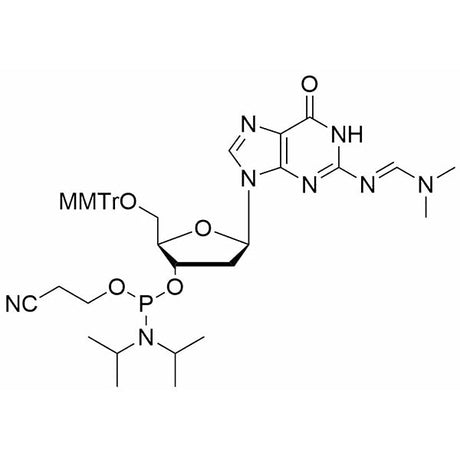
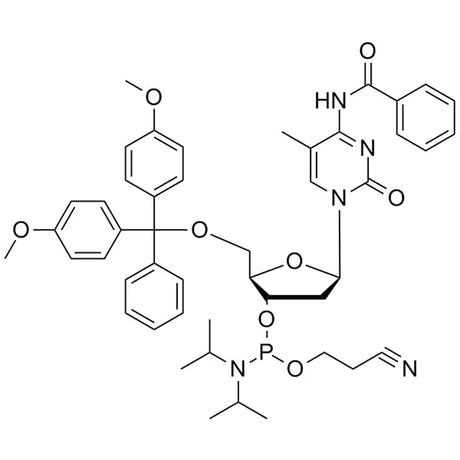
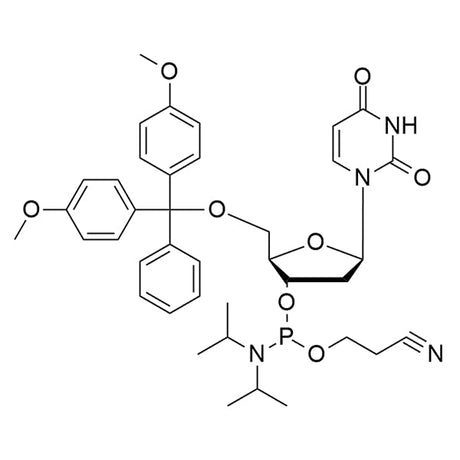
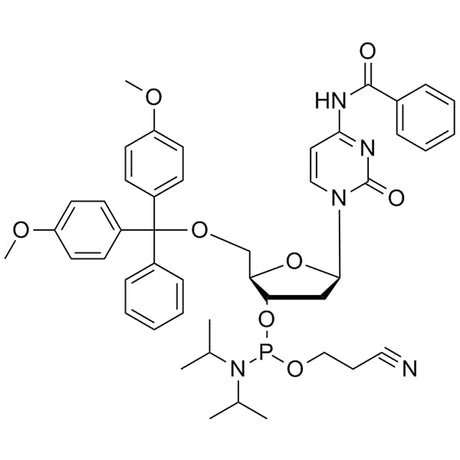
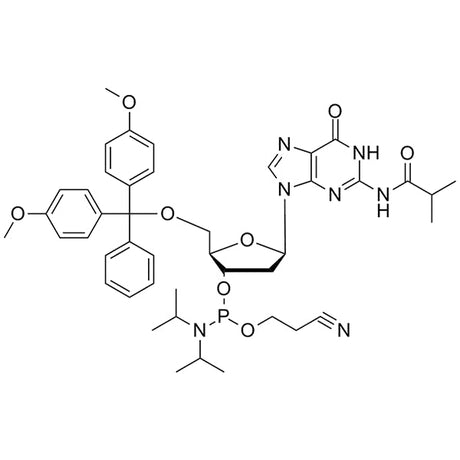
What are DNA Phoshporamidites? DNA Phosphoramidites are the core monomeric building blocks used in solid‑phase phosphoramidite chemistry for the automated synthesis of synthetic oligonucleotides. Each DNA phosphoramidite molecule is a precisely protected and activated deoxynucleotide unit, much like a custom‑designed “brick” for constructing a DNA chain.
From a chemical structure perspective, a standard DNA phosphoramidite monomer contains three key parts:
Nucleobase (A, G, C, T) – carries the genetic information. The exocyclic amines on A, G and C are temporarily blocked by protecting groups (e.g., benzoyl (Bz), isobutyryl (iBu), acetyl (Ac) or fast‑deprotecting groups like dmf/tac) to prevent side reactions during chain assembly.
3′-Phosphoramidite group – a highly reactive moiety. In the presence of an activator (e.g., tetrazole), it couples with the free 5′‑hydroxyl group of the growing DNA chain, thereby adding the next nucleotide to the sequence.
5′-DMT protecting group (4,4′-dimethoxytrityl) – acts as a “chemical cap” that blocks the 5′‑hydroxyl. It is selectively removed by mild acid only at the beginning of each synthesis cycle, exposing the hydroxyl for the next coupling. This design ensures that exactly one monomer is added per cycle, enabling precise sequence control.
In an automated DNA synthesizer, the synthesis proceeds through a four‑step cycle:
Deblocking – dichloroacetic or trichloroacetic acid removes the DMT group, freeing the 5′‑OH of the DNA chain attached to the solid support.
Cuppling – the next DNA phosphoramidite and an activator (e.g., tetrazole) are introduced. The activator activates the phosphoramidite, which rapidly reacts with the 5′‑OH to form a phosphite triester bond.
Capping – any unreacted 5′‑OH groups are acetylated (e.g., with acetic anhydride) to prevent formation of deletion (n‑1) impurities.
Oxidation – the unstable phosphite triester is oxidized (typically with iodine) to a stable phosphate diester, which forms the natural DNA backbone.
Repeating this cycle allows efficient synthesis of defined DNA sequences longer than 200 bases. All DNA phosphoramidites supplied by Hongene meet the stringent requirements for purity, reactivity and stability demanded by this synthetic process.
Hongene’s Core Advantages for DNA Phosphoramidites
Complete Product Portfolio – Standard to Specialty Monomers
Standard A, G, C, T monomers with various protecting groups (Bz, iBu, Ac, dmf, etc.)
Functionalized monomers for fluorescent dyes (FAM, TAMRA, Cy3, Cy5), quenchers (BHQ, DusQ), amino, thiol, biotin, GalNAc, cholesterol, etc.
Ultra‑High Purity & Rigorous Quality Control
Each batch tested by HPLC/UPLC – typical purity 96% – ≥98% (key monomers ≥99%)
Full Certificate of Analysis (CoA) including purity, moisture, retention time, mass spectrometry and impurity profiles
In‑house impurity reference standard library built from decades of manufacturing data, enabling precise tracking of degradation and process‑related impurities
GMP Compliance & Large‑Scale Commercial Supply
Manufacturing follows strict GMP standards; successfully audited by multiple major European and US pharmaceutical companies
Annual production capacity: 58 tons of phosphoramidites and 54,000 L of NTPs
Reliable supply from gram to kilogram scale for R&D, clinical and commercial batches
During the COVID‑19 pandemic, Hongene was among the world’s largest suppliers of mRNA vaccine raw materials – proven large‑scale delivery capability
Continuous Innovation & Technical Support
Licensed novel backbone modification technologies (e.g., exNA™) through collaboration with top research institutes such as UMass Medical School, enabling next‑generation oligonucleotide therapeutics
In‑house technical team offers impurity profiling, synthesis process optimization and custom monomer development
Fluorescent probes (TaqMan, molecular beacons, FRET probes), FISH probes, LNA/modified probes, isothermal amplification primers – for infectious diseases, cancer biomarkers, genetic disorders and pharmacogenomics.
Nucleic Acid Drug Development
Raw materials for antisense oligonucleotides (ASOs), siRNA, aptamers, CRISPR guide RNA (gRNA), and DNAzymes. Hongene’s GMP‑grade phosphoramidites have supported multiple clinical‑stage and approved nucleic acid drugs.
mRNA Vaccines & Gene Therapy
Synthesis of long DNA templates for in vitro transcription of mRNA and saRNA. Hongene products are widely used in both R&D and commercial manufacturing of mRNA vaccines.
Functional DNA Nanotechnology
Introduction of amino, thiol, fluorescent dyes, quenchers, biotin, cholesterol, GalNAc and other ligands for biosensors, DNA origami, targeted drug delivery and cellular imaging.