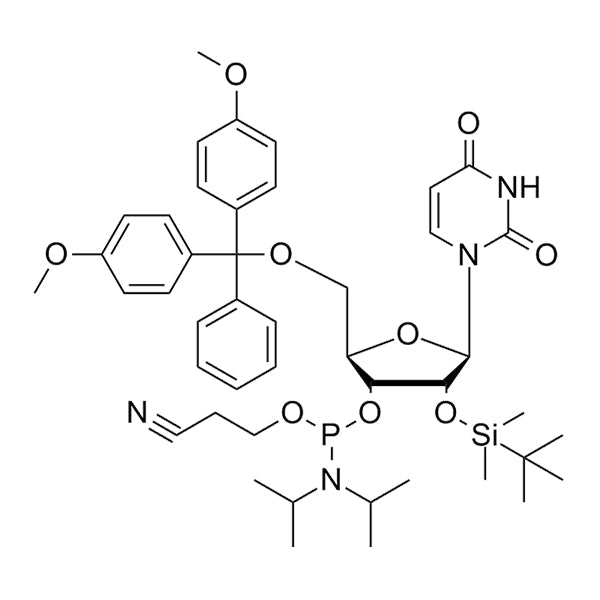

DMT-2'-O-TBDMS-U-CE Phosphoramidite
| Catalog No. | PR5-003 |
| CAS No. | 118362-03-1 |
| Purity | HPLC ≥98.0% |
| Molecular Formula | C45H61N4O9PSi |
| Molecular Weight | 861.05 |
| Storage Condition | -20℃ |
DMT-2'-O-TBDMS-U-CE Phosphoramidite
DMT-2'-O-TBDMS-U-CE Phosphoramidite - N (Normal) / 0.25g / 30mL screwed bottle-28 is backordered and will ship as soon as it is back in stock.
Couldn't load pickup availability
Shipping notes
Shipping notes
Details
Details
DMT-2'-O-TBDMS-U-CE-Phosphoramidite is a protected ribonucleoside building block used for solid-phase RNA oligonucleotide synthesis. It contains a 5'-dimethoxytrityl (DMT) protecting group for 5'-hydroxyl protection, a 2'-O-tert-butyldimethylsilyl (TBDMS) protecting group for 2'-hydroxyl protection, a cyanoethyl (CE) protecting group on phosphite, and a uracil.
TBDMS offers excellent stability for protecting 2'-hydroxyl of ribonucleosides during acid detritylation and oxidation steps.
TBDMS deprotection can be achieved using fluoride reagents (e.g., tetrabutylammonium fluoride (TBAF) and triethylamine trihydrofluoride (TEA·3HF)), which can cleave the silyl group without damaging the RNA backbone.
Applications
Synthetic RNA oligonucleotides
Monomer for preparing functional RNA sequences used in biochemical assays and binding studies,[1] such as RNA aptamers and ribozymes.
Mixed backbone design
Enables the synthesis of RNA-DNA chimeras, e.g., chimeric RNA/DNA oligonucleotide-based gene therapy.[2][3]
Features and Benefits
Other Notes
- Storage: Store in a dry, inert atmosphere at -20 °C.
- Coupling: 12 minutes coupling time recommended
- Compatibility: Can be used alongside modified phosphoramidites (e.g., 2′-OMe, 2′-MOE, Locked-NA) to synthesize chimeric oligonucleotides.
Reference
Specifications
Specifications
-
Catalog No.PR5-003PR5-003PR5-003PR5-003PR5-003PR5-003PR5-003PR5-003
-
CAS No.118362-03-1118362-03-1118362-03-1118362-03-1118362-03-1118362-03-1118362-03-1118362-03-1
-
SMILESC[Si](C)(C(C)(C)C)O[C@@H]1[C@H](OP(OCCC#N)N(C(C)C)C(C)C)[C@@H](COC(C2=CC=C(OC)C=C2)(C3=CC=CC=C3)C4=CC=C(OC)C=C4)O[C@H]1N(C=C5)C(NC5=O)=OC[Si](C)(C(C)(C)C)O[C@@H]1[C@H](OP(OCCC#N)N(C(C)C)C(C)C)[C@@H](COC(C2=CC=C(OC)C=C2)(C3=CC=CC=C3)C4=CC=C(OC)C=C4)O[C@H]1N(C=C5)C(NC5=O)=OC[Si](C)(C(C)(C)C)O[C@@H]1[C@H](OP(OCCC#N)N(C(C)C)C(C)C)[C@@H](COC(C2=CC=C(OC)C=C2)(C3=CC=CC=C3)C4=CC=C(OC)C=C4)O[C@H]1N(C=C5)C(NC5=O)=OC[Si](C)(C(C)(C)C)O[C@@H]1[C@H](OP(OCCC#N)N(C(C)C)C(C)C)[C@@H](COC(C2=CC=C(OC)C=C2)(C3=CC=CC=C3)C4=CC=C(OC)C=C4)O[C@H]1N(C=C5)C(NC5=O)=OC[Si](C)(C(C)(C)C)O[C@@H]1[C@H](OP(OCCC#N)N(C(C)C)C(C)C)[C@@H](COC(C2=CC=C(OC)C=C2)(C3=CC=CC=C3)C4=CC=C(OC)C=C4)O[C@H]1N(C=C5)C(NC5=O)=OC[Si](C)(C(C)(C)C)O[C@@H]1[C@H](OP(OCCC#N)N(C(C)C)C(C)C)[C@@H](COC(C2=CC=C(OC)C=C2)(C3=CC=CC=C3)C4=CC=C(OC)C=C4)O[C@H]1N(C=C5)C(NC5=O)=OC[Si](C)(C(C)(C)C)O[C@@H]1[C@H](OP(OCCC#N)N(C(C)C)C(C)C)[C@@H](COC(C2=CC=C(OC)C=C2)(C3=CC=CC=C3)C4=CC=C(OC)C=C4)O[C@H]1N(C=C5)C(NC5=O)=OC[Si](C)(C(C)(C)C)O[C@@H]1[C@H](OP(OCCC#N)N(C(C)C)C(C)C)[C@@H](COC(C2=CC=C(OC)C=C2)(C3=CC=CC=C3)C4=CC=C(OC)C=C4)O[C@H]1N(C=C5)C(NC5=O)=O
-
Molecular FormulaC45H61N4O9PSiC45H61N4O9PSiC45H61N4O9PSiC45H61N4O9PSiC45H61N4O9PSiC45H61N4O9PSiC45H61N4O9PSiC45H61N4O9PSi
-
Molecular Weight861.05861.05861.05861.05861.05861.05861.05861.05
-
AppearanceWhite to light yellow powder, free from visible foreign matterWhite to light yellow powder, free from visible foreign matterWhite to light yellow powder, free from visible foreign matterWhite to light yellow powder, free from visible foreign matterWhite to light yellow powder, free from visible foreign matterWhite to light yellow powder, free from visible foreign matterWhite to light yellow powder, free from visible foreign matterWhite to light yellow powder, free from visible foreign matter
-
PurityHPLC ≥98.0%HPLC ≥98.0%HPLC ≥98.0%HPLC ≥98.0%HPLC ≥98.0%HPLC ≥98.0%HPLC ≥98.0%HPLC ≥98.0%
-
Storage Condition-20℃-20℃-20℃-20℃-20℃-20℃-20℃-20℃
-
Moisture ContentK.F.≤0.20% w/wK.F.≤0.20% w/wK.F.≤0.20% w/wK.F.≤0.20% w/wK.F.≤0.20% w/wK.F.≤0.20% w/wK.F.≤0.20% w/wK.F.≤0.20% w/w
Documentation
Documentation
DMT-2'-O-TBDMS-U-CE-Phosphoramidite is a protected ribonucleoside building block used for solid-phase RNA oligonucleotide synthesis. It contains a 5'-dimethoxytrityl (DMT) protecting group for 5'-hydroxyl protection, a 2'-O-tert-butyldimethylsilyl (TBDMS) protecting group for 2'-hydroxyl protection, a cyanoethyl (CE) protecting group on phosphite, and a uracil.
TBDMS offers excellent stability for protecting 2'-hydroxyl of ribonucleosides during acid detritylation and oxidation steps.
TBDMS deprotection can be achieved using fluoride reagents (e.g., tetrabutylammonium fluoride (TBAF) and triethylamine trihydrofluoride (TEA·3HF)), which can cleave the silyl group without damaging the RNA backbone.
Applications
Synthetic RNA oligonucleotides
Monomer for preparing functional RNA sequences used in biochemical assays and binding studies,[1] such as RNA aptamers and ribozymes.
Mixed backbone design
Enables the synthesis of RNA-DNA chimeras, e.g., chimeric RNA/DNA oligonucleotide-based gene therapy.[2][3]
Features and Benefits
Other Notes
- Storage: Store in a dry, inert atmosphere at -20 °C.
- Coupling: 12 minutes coupling time recommended
- Compatibility: Can be used alongside modified phosphoramidites (e.g., 2′-OMe, 2′-MOE, Locked-NA) to synthesize chimeric oligonucleotides.
Reference
-
Catalog No.PR5-003PR5-003PR5-003PR5-003PR5-003PR5-003PR5-003PR5-003
-
CAS No.118362-03-1118362-03-1118362-03-1118362-03-1118362-03-1118362-03-1118362-03-1118362-03-1
-
SMILESC[Si](C)(C(C)(C)C)O[C@@H]1[C@H](OP(OCCC#N)N(C(C)C)C(C)C)[C@@H](COC(C2=CC=C(OC)C=C2)(C3=CC=CC=C3)C4=CC=C(OC)C=C4)O[C@H]1N(C=C5)C(NC5=O)=OC[Si](C)(C(C)(C)C)O[C@@H]1[C@H](OP(OCCC#N)N(C(C)C)C(C)C)[C@@H](COC(C2=CC=C(OC)C=C2)(C3=CC=CC=C3)C4=CC=C(OC)C=C4)O[C@H]1N(C=C5)C(NC5=O)=OC[Si](C)(C(C)(C)C)O[C@@H]1[C@H](OP(OCCC#N)N(C(C)C)C(C)C)[C@@H](COC(C2=CC=C(OC)C=C2)(C3=CC=CC=C3)C4=CC=C(OC)C=C4)O[C@H]1N(C=C5)C(NC5=O)=OC[Si](C)(C(C)(C)C)O[C@@H]1[C@H](OP(OCCC#N)N(C(C)C)C(C)C)[C@@H](COC(C2=CC=C(OC)C=C2)(C3=CC=CC=C3)C4=CC=C(OC)C=C4)O[C@H]1N(C=C5)C(NC5=O)=OC[Si](C)(C(C)(C)C)O[C@@H]1[C@H](OP(OCCC#N)N(C(C)C)C(C)C)[C@@H](COC(C2=CC=C(OC)C=C2)(C3=CC=CC=C3)C4=CC=C(OC)C=C4)O[C@H]1N(C=C5)C(NC5=O)=OC[Si](C)(C(C)(C)C)O[C@@H]1[C@H](OP(OCCC#N)N(C(C)C)C(C)C)[C@@H](COC(C2=CC=C(OC)C=C2)(C3=CC=CC=C3)C4=CC=C(OC)C=C4)O[C@H]1N(C=C5)C(NC5=O)=OC[Si](C)(C(C)(C)C)O[C@@H]1[C@H](OP(OCCC#N)N(C(C)C)C(C)C)[C@@H](COC(C2=CC=C(OC)C=C2)(C3=CC=CC=C3)C4=CC=C(OC)C=C4)O[C@H]1N(C=C5)C(NC5=O)=OC[Si](C)(C(C)(C)C)O[C@@H]1[C@H](OP(OCCC#N)N(C(C)C)C(C)C)[C@@H](COC(C2=CC=C(OC)C=C2)(C3=CC=CC=C3)C4=CC=C(OC)C=C4)O[C@H]1N(C=C5)C(NC5=O)=O
-
Molecular FormulaC45H61N4O9PSiC45H61N4O9PSiC45H61N4O9PSiC45H61N4O9PSiC45H61N4O9PSiC45H61N4O9PSiC45H61N4O9PSiC45H61N4O9PSi
-
Molecular Weight861.05861.05861.05861.05861.05861.05861.05861.05
-
AppearanceWhite to light yellow powder, free from visible foreign matterWhite to light yellow powder, free from visible foreign matterWhite to light yellow powder, free from visible foreign matterWhite to light yellow powder, free from visible foreign matterWhite to light yellow powder, free from visible foreign matterWhite to light yellow powder, free from visible foreign matterWhite to light yellow powder, free from visible foreign matterWhite to light yellow powder, free from visible foreign matter
-
PurityHPLC ≥98.0%HPLC ≥98.0%HPLC ≥98.0%HPLC ≥98.0%HPLC ≥98.0%HPLC ≥98.0%HPLC ≥98.0%HPLC ≥98.0%
-
Storage Condition-20℃-20℃-20℃-20℃-20℃-20℃-20℃-20℃
-
Moisture ContentK.F.≤0.20% w/wK.F.≤0.20% w/wK.F.≤0.20% w/wK.F.≤0.20% w/wK.F.≤0.20% w/wK.F.≤0.20% w/wK.F.≤0.20% w/wK.F.≤0.20% w/w
Why choose Hongene?
Trusted Partner in Nucleic Acid
Enjoy enterprise‑grade quality even with small batch orders.
Integrated Supply & Commercial Scale
With nearly 30 years of expertise, we control a secure supply chain for RNA raw materials and provide reliable GMP-grade oligo synthesis from research to commercial kilogram-scale production.
Proprietary Technology & IP
Our proprietary Chemoenzymatic Ligation Platform combines chemical andenzymatic methods, enabling high-putity, cost-effective, and large-scale production of RNA-based therapeutics.
Rigorous Quality
We implement multiple stringent QC steps, maintain ISO certifications, and ensure >99% batch-to-batch consistency, reducing scale-up and PPQ risks.
Manufacturing Scalability
Hongene operates a 1.67-million-square-foot oligonucleotide manufacturing facility featuring advanced equipment, including multiple OligoPilot™ and OligoProcess™ synthesizers ranging from 10 to 1,800 mmol. Its 48 flexible production lines enable seamless, one-stop scale-up of API production from gram-level quantities to metric tons, achieving purity of ≥98% while supporting compliance with NMPA, FDA, and EMA regulatory requirements.
Global Business Network
Our products and services reach over 40 countries and regions, supporting around 3,000 clients worldwide.